Highlights
- Liberty, power, and moral paradoxes behind perfect walls
- Diplomacy, slave trade, saints and political rebels
- A thought-provoking tour for curious, analytical travelers
Description
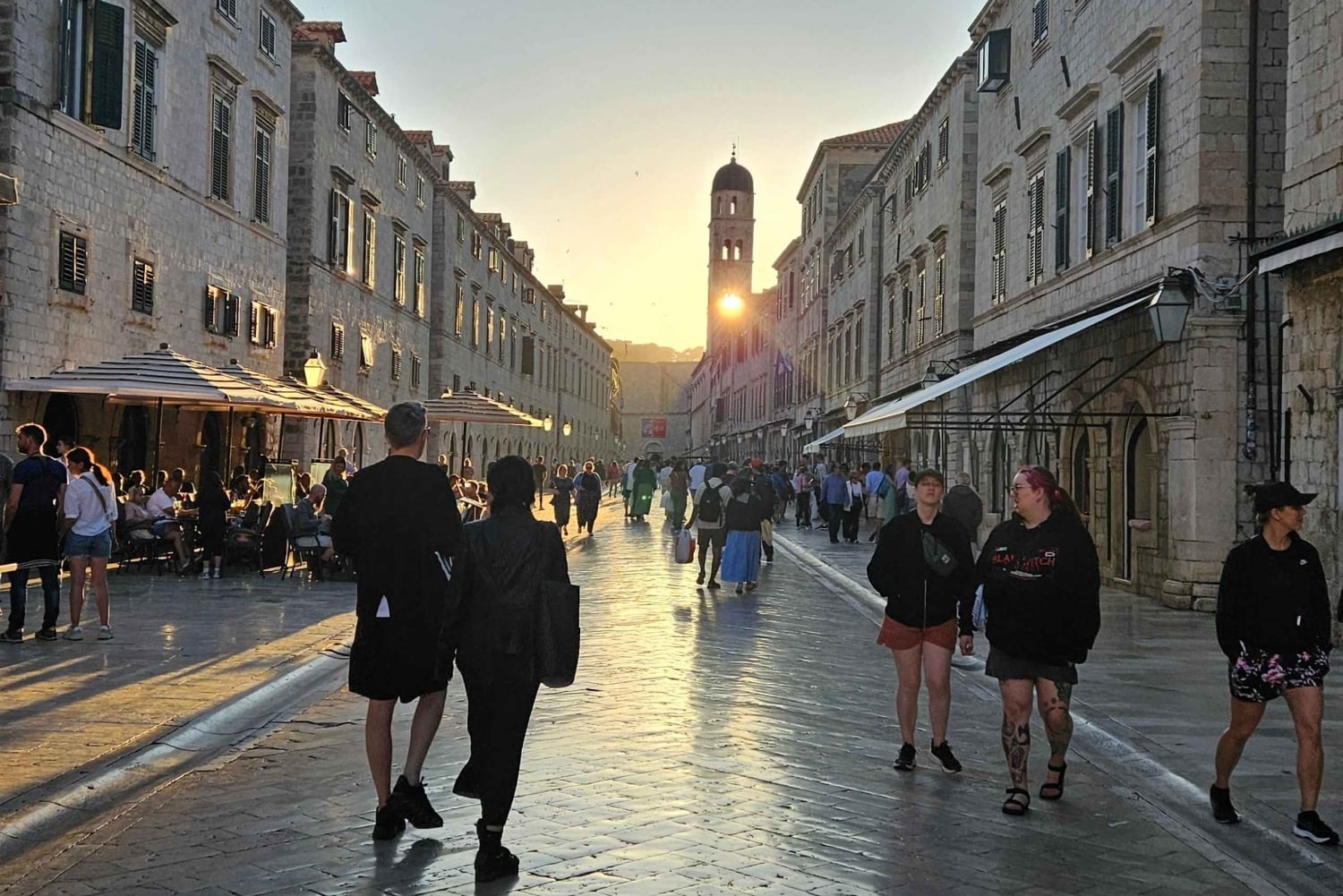
Dubrovnik looks perfect.
Polished limestone streets. Elegant palaces. Defensive walls rising confidently above the sea. A city that calls itself Libertas — freedom.
But no republic survives for 450 years on beauty alone.
Saints & Sinners is not a standard historical walk. This is a story about power, ambition, discipline, and moral compromise. It is about the fragile balance between idealism and survival.
We begin at Ploče Gate, beneath Fort Revelin — a reminder that even the most diplomatic republic relied on artillery. Here you’ll meet Ivan Rabljanin, the master craftsman who cast the cannons that defended Dubrovnik. Art in the service of war. Beauty in the service of power.
From there we descend to the Old Port, where trade made Dubrovnik rich. The Republic famously banned the slave trade in 1416 — earlier than many European states. But history is rarely simple. Before that ban, and sometimes indirectly after it, Dubrovnik’s merchants operated within wider systems connected to slavery. This stop confronts a difficult question: can a republic built on liberty also profit from injustice?
At the Rector’s Palace, we examine one of Europe’s most sophisticated political systems — a republic designed with strict checks and balances long before modern constitutions. Power rotated monthly to prevent dictatorship. Stability was sacred. But stability came at a cost. Through the life of Marojica Kaboga, we explore how rigid systems protect freedom — and sometimes crush individuality.
Behind the Cathedral, we encounter Stjepan Gradić, the diplomat who helped rebuild Dubrovnik after the catastrophic earthquake of 1667. In a moment of collapse, he chose service over self-interest. If Dubrovnik has a civic saint, he is one of them.
At the Jesuit complex, we meet Ruđer Bošković — scientist, Jesuit, and intellectual visionary whose ideas anticipated modern atomic theory. His mind was global; his homeland was small. Dubrovnik valued knowledge, but within limits.
In the home of Miho Pracat, we discover the story of a self-made merchant who left his fortune to charity, associated with Blaga djela — “Good Works.” In a closed aristocracy, generosity created a legacy that birth could not.
Through the satire of Marin Držić, the poetry of Junije Palmotić, and the refined influence of Cvijeta Zuzorić, we uncover the cultural brilliance of the Republic — and its boundaries.
We end before the Church of St. Blaise, the city’s patron saint and symbolic protector. He holds Dubrovnik in his hand — a city built not only by saints, but by sinners, pragmatists, idealists, reformers, and survivors.
This tour is for travelers who want more than dates and architecture.
It is for those curious about how republics truly function — how they balance liberty with control, morality with profit, and ideals with survival.
Dubrovnik was not perfect.
It was human.
And perhaps that is why it endured.
Includes
Professional guided tour
Excludes
Food and drinks
Souvenirs
Important Information
- This tour is not suitable for children under 12 due to the serious and complex historical themes discussed. We will also be walking and climbing several staircases (not excessively), so participants should be comfortable with moderate physical activity.
Easy cancellation
Cancel up to 24 hours in advance for a full refund